Hengrui's 2024 annual report says this on page 52:
自2018年以来,公司与全球合作伙伴进行了13笔对外许可交易,涉及16个分子实体,潜在总交易额约为140亿美元,首付款总额约为6亿美元,另获得若干合作伙伴的股权。 (Since 2018 the Company has conducted 13 out-licensing transactions with global partners, covering 16 molecular entities, with potential total transaction value of approximately US$14.0 billion and total upfront payments of approximately US$600 million, and has separately acquired equity in several of the partners.)
It says much the same thing again on page 43, in a longer sentence that carries on into a line about global influence. The last clause of the page 52 version, the one about equity, is doing a lot of work, and I will come back to it. But start with the two numbers in the middle, because Hengrui has published the thing everyone else has to estimate: the aggregate of what its deals were announced at, and the aggregate of what was actually paid at signing. You will not find that in a database. It is in the annual report, in Chinese, in a paragraph about global expansion.
Most of the people quoting these deals have not read it.
I spent thirty years on the buy side — BMS, Wyeth, then WuXi AppTec and CrownBio — which mostly means I have sat in the rooms where these agreements get argued over rather than announced. What follows is not a view about whether Chinese assets are underpriced. It is a description of which documents say what, and what each one will and will not tell you. My examples are drawn mainly from metabolic and obesity deals, because that is where I have read the paperwork most recently, but nothing about the mechanics is specific to the therapeutic area. If you are preparing to license something out, you can run every check below yourself in an afternoon.
The announcement and the filing are different documents
Take the deal everyone cites.
In May 2024 Hengrui licensed its GLP-1 portfolio to a US newco that became Kailera Therapeutics. The number attached to it in a good deal of the coverage, and in most conversation about it, is six billion dollars. Kailera's IPO prospectus, filed in April 2026, describes the same transaction like this:
we paid Hengrui an upfront payment of $100 million, issued Hengrui 5,677,603 shares of our preferred stock, valued at approximately $96.4 million at the time of issuance, and paid Hengrui a technology transfer payment of $10.0 million
and then:
(A) clinical and regulatory milestone payments of up to an aggregate of $200.0 million, (B) commercial milestone payments of up to an aggregate of $5.725 billion
Add the cash, the technology-transfer fee and both milestone tiers and you get $6.035 billion, so the six-billion figure is not invented. It is the sum of everything the contract could ever pay under any circumstance. The cash was $100 million at signing in May 2024, with the $10 million technology-transfer fee following in December, plus stock representing 19.9% of the company on a fully diluted basis.
I want to be careful here, because the easy version of this observation is wrong. It is not true that the press universally inflated this deal. BioPharma Dive's launch coverage said Kailera “licensed the drug candidates from Hengrui for $110 million in upfront and near-term payments as well as a roughly 20% equity stake,” and gave no biobucks total at all. Some outlets read the filing. Others read the press release. The difference is visible if you check, and checking takes about ten minutes.
The prospectus also contains something no announcement carried. Hengrui held a claim on any partnering deal Kailera signed before 15 November 2025 — if Kailera had partnered the assets onward inside that window, a share of the proceeds would have been owed back to Hengrui. Kailera booked that obligation as a derivative worth $4.8 million. The date passed without a partnering deal and it expired unused.
None of this is hidden. The prospectus is public and EDGAR indexes its full text.
Three things the announcement will never tell you
The upfront is a gross number. In March 2025 The United Laboratories announced that its subsidiary would receive a $200 million upfront from Novo Nordisk for UBT251. In June it announced what arrived:
received the upfront payment of US$180 million (after deduction of Danish withholding tax)
Twenty million dollars, or ten percent, went to the Danish tax authority. The same thing happened to the first milestone a year later, and there the announcement skipped the gross figure entirely and reported only what landed: $13.5 million, again stated as net of Danish withholding tax. Whether you can credit that against Chinese tax depends on your structure and on the treaty, and it is not my area.
None of that is a scoop, and I want to be straight about it. 每日经济新闻 reported it on 17 July 2026, named the deduction, and reconciled the net figure against the RMB 1.442 billion of licence income in the FY2025 accounts. If you follow the Chinese coverage you already knew.
What is worth your attention is what happened next. Both numbers are now in circulation, and people are using the wrong one. A 浙商证券 note carried by 界面新闻 in June 2026 lists this deal in a table of licensing comparables at 首付款2亿美金 — the announced figure — in the same weeks 每日经济新闻 was reporting 1.8亿 as the amount received. 招商证券(香港) uses 1.8亿 with no note that it is net. At least one widely-shared WeChat post refers to 已到账的2亿美元首付款, which did not happen.
So when you benchmark against a comparables table, check which number it used. Some of the tables in circulation are gross, some are net, and none of them say which. That is a five-minute check on your own model and I would do it before your next negotiation.
One practical note, since it is the reason this is easy to miss. The company's Chinese announcement says 预缴税, not the 预提税 or 预扣税 you would probably search for, and every outlet copies the company's wording. Search the company's term, not the textbook one.
Equity is worth what the buyer's auditors say it is worth. In September 2025 Hengrui licensed a cardiac myosin inhibitor to Braveheart Bio and announced $65 million upfront: $32.5 million in cash, and 32.5 million shares issued at one dollar each. Braveheart's own S-1 records the share leg differently:
the corresponding fair value of the non-voting Series A preferred stock issued was $0.79 per share, representing total equity consideration of $25.7 million
Issued at a dollar, booked at seventy-nine cents. The buyer's auditors applied a discount for non-voting, illiquid preferred stock in a private company, which is ordinary practice. So the announced consideration is $65 million and the consideration as recorded by the counterparty is $32.5 million of cash plus $25.7 million of stock, or $58.2 million. Both numbers are honest. They answer different questions.
Somebody has already priced your buyer reselling you. The Braveheart agreement, the actual executed contract filed as an exhibit, defines a “Flipping Transaction”: if the newco undergoes a change of control, disposes of the licence, or sublicenses into the US, the major European markets or Japan within eighteen months, it owes Hengrui a share of the proceeds. That share is not flat: for a change of control it tapers away over the first nine months, and it pays nothing at all unless the transaction values the newco well above what Hengrui's licence was struck at. This is the same device as the Kailera partnering claim described above, written as an explicit contract term with its own schedule rather than as a derivative on a balance sheet.
The obvious inference is that Chinese licensors have invented a protective device. That inference is wrong, and I checked before writing it. The same device appears in an agreement between two non-Chinese companies, Metsera and D&D Pharmatech (Korean, not Chinese), as a “Change of Control Fee.” The terms differ in the detail. Metsera's triggers on change of control alone, is gated on reaching Phase II, and is capped at $35 million. But the idea is a standard newco term, not a Chinese innovation. What is unusual is not that Hengrui uses it but that you can read it at all, and that is a point about disclosure rather than about negotiation.
Whether you learn the milestone split is the seller's choice, not a rule
These out-licensing deals are not notifiable transactions under the HKEX Listing Rules. Hansoh says so in all seven of its licence announcements, and United Laboratories says it too, in the same words: the agreements are “of a revenue nature in the ordinary and usual course of business of the Group and do not constitute any notifiable transactions or connected transactions of the Company under the Listing Rules.” CSPC and Innovent do not say it, because their announcements carry no Listing Rules section at all. No circular is triggered either way. Nothing compels a breakdown of the milestone stack.
So whether you can see the split is entirely the issuer's decision. It turns out to run by issuer rather than by deal, with one instructive exception below.
CSPC usually discloses it. Its January 2026 announcement of the AstraZeneca alliance separates the tiers cleanly: $1.2 billion upfront, up to $3.5 billion of research and development milestones, up to $13.8 billion of sales milestones, up to double-digit royalties. You can see immediately that three quarters of the headline sits behind sales gates — 13.8 against 18.5. Its June 2025 announcement of a separate collaboration is broken out the same way, and when a milestone actually arrived in July 2026 it announced that too, with the amount.
Usually, not always. Its July 2025 licence of an oral GLP-1 to Madrigal gives “an upfront payment of US$120 million plus potential development, regulatory, and commercial milestone payments of up to US$1.955 billion” — one bundled number, in the same therapeutic area, from the issuer I have just called the good example. Five of its remaining out-licences do split. The habit is real. It is not a rule.
Hansoh does not. Across seven out-licensing announcements and a 169-page annual report there is no split anywhere. Its December 2024 announcement of the MSD licence gives one number for everything:
an upfront payment of US$112 million and be eligible to receive up to US$1.9 billion in milestone payments associated with and subject to the development, regulatory approval and commercialization of the Product
Development, regulatory and commercial, bundled. Its Glenmark deal goes further and gives no upfront figure at all. Innovent's out-licences carry no split either. United Laboratories has only ever done one out-licensing deal, so there is no pattern to read there. One data point is not a habit.
Merck's FY2025 10-K, describing the same Hansoh agreement from the buyer's side, gives the split Hansoh never published:
contingent development-related milestone payments of up to $115 million (of which $15 million was paid in 2025), regulatory milestone payments of up to $315 million and sales-based milestone payments of up to $1.47 billion
$115 million development, $315 million regulatory, $1.47 billion sales-based. Roughly three quarters of that stack is commercial.
Coverage of the same transaction, by the document you are reading.
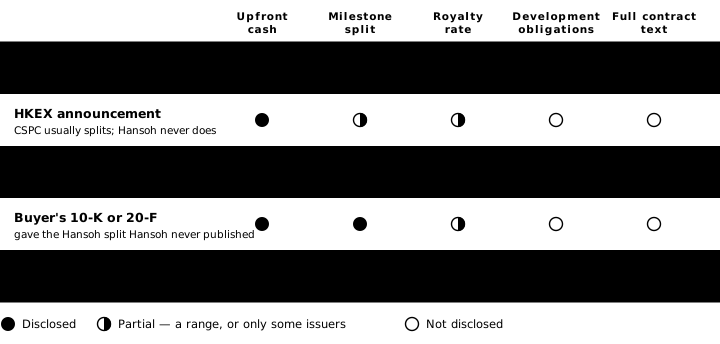
If the buyer is a US filer, the buyer's regulator will often disclose what the seller's did not. That is the single most useful mechanical fact in this piece. When a Chinese company announces a deal with Merck, Pfizer, Regeneron or any other 10-K filer and gives you one aggregate milestone number, go and read the buyer's annual report. Look in the acquisitions and licensing note. The split is frequently there, and so, occasionally, is the payment history.
What has actually been paid
Announced milestone ceilings are potential. Payments are events, and events get disclosed.
Within the metabolic and obesity deals I went through, which is the scope of my examples throughout rather than a census of Chinese licensing, four post-signing payments are on the public record. Eccogene received $60 million from AstraZeneca in October 2024, on a milestone package that included first-patient-dosed in a global Phase 2b: about eleven months after signing, and 3.3% of that deal's $1.825 billion ceiling. Hansoh received $15 million from Merck in 2025. CSPC received $25 million from AstraZeneca in July 2026. United Laboratories received $13.5 million from Novo Nordisk in July 2026, and that one is a net figure where the other three are gross.
Hengrui also collected $3 million and $6 million in technology-transfer milestones from Braveheart in early 2026, but that is the cardiac asset, not a metabolic one. I keep it out of the total because the metabolic deals are the comparable set. I use the Braveheart contract elsewhere for its terms, which is a different thing from counting its payments here.
Two observations.
The first is arithmetic: those four payments total $113.5 million against ceilings measured in tens of billions. That ratio will look alarming, and I would not lean on it. These are deals signed one to three years ago, several of them on preclinical or Phase 1 assets. Development milestones are not due yet. A low realised fraction on a young portfolio tells you about the calendar, not about the counterparty.
The second is that milestones plainly do get paid, and the same Merck 10-K shows it. At the end of 2025 Merck was carrying accrued liabilities of $890 million for contingent sales-based milestones under its Alteogen licence. Accrued, in US accounting, means the company judges those payments probable, a higher bar than more-likely-than-not. It had already paid $40 million of regulatory milestones under that same agreement during the year, plus $300 million to LaNova and $20 million to Kelun. None of those three is a metabolic deal — I am using them to show that milestone tiers do pay, not as comparables. Eccogene's $60 million arrived faster and larger than anything else in the set I looked at. If someone tells you biobucks never pay, that is as unexamined as the claim that the headline is real.
What you should take from those four payment events is narrower and more practical: payment events are disclosable and disclosed. When you are diligencing a comparable, do not stop at the announcement. Search the licensor's subsequent filings for the deal name. If a milestone was hit, somebody said so.
Where the documents are
For SSE and SZSE filers, start at cninfo, which carries both exchanges. Hengrui's 2024 annual report is `static.cninfo.com.cn/finalpage/2025-03-31/1222961962.PDF`. The out-licensing paragraph is on pages 43 and 52. Announcements of individual deals are filed as 临时公告 (interim announcements) and often carry more granular terms than the equivalent Hong Kong announcement — Hengrui's Kailera announcement, 临2024-060, tiers the deal in full: $110 million upfront and near-term, 19.9% equity, up to $200 million clinical and regulatory, up to $5.725 billion in sales milestones. There is no Hong Kong announcement of that deal at all, because Hengrui did not list in Hong Kong until May 2025, a year and a week after signing.
For HKEX filers, hkexnews is the official source and is frequently unreachable to anything automated. Two workarounds, and the second is the one that generalises. `doc.irasia.com` mirrors verbatim PDFs under a predictable path, but it covers only about 12% of HKEX issuers and almost no China pharma. CSPC and United Laboratories are there; Hansoh, Innovent, Hengrui, Akeso, Kelun, BeiGene and Zai Lab are not. What works everywhere is the issuer's own investor-relations page: most of these companies run their IR newsroom on Euroland, and the announcement PDFs sit on `ea-cdn.eurolandir.com` behind a JSON news feed. That is how I pulled the Hansoh announcement quoted above.
For the buyer's side, EDGAR full-text search covers filings from 2001 onward — every 10-K, 20-F, S-1 and 8-K in that window. Search the asset code, not the company name — internal codes are unique and company names are everywhere. Where the licensee is a small registrant rather than large pharma, you sometimes get the executed contract itself as an exhibit, redactions and all. That is how Braveheart's tier maxima are readable at all, and how you can see that a Flipping Transaction clause exists — though its actual sharing percentages sit behind [*] redactions, like most of the individual milestone rows.
What you cannot learn this way
Two deal terms, and then a warning about a third kind of number.
Development obligations are not disclosed. I went through seven China-to-West licences where large pharma is the buyer and the economics were disclosed. Six are metabolic: Merck's two, with Hansoh and with Hengrui; three of AstraZeneca's, being the January 2026 obesity alliance with CSPC, an earlier October 2024 Lp(a) licence also from CSPC, and the Eccogene oral GLP-1; and Novo Nordisk's with United Laboratories. The seventh, CSPC's June 2025 small-molecule collaboration with AstraZeneca, is not metabolic. I include it because it is the same counterparty disclosing the same way, and I flag it rather than quietly widening the set. Not one disclosed an anti-shelving provision, a diligence standard, a minimum spend, a reversion right, or a hard deadline. Not one. These terms exist. Braveheart's S-1 confirms its agreement carries regulatory milestone obligations within specified timelines, and Kailera's confirms diligence obligations covering at least four licensed products. But they are visible only because a newco has to describe the licence it depends on. When large pharma is the licensee, the agreement is immaterial to a company that size and never appears as an exhibit.
One caveat I should put on that myself, because it is the obvious objection: I selected those seven on the basis that their economics were disclosed, and then used them to measure disclosure. The deals that withhold their economics — Hansoh's Glenmark licence gives no upfront figure at all — are if anything less likely to volunteer a development obligation, so I think the finding holds. But it is a sample chosen on the thing it measures, and you should know that.
Either way, you cannot benchmark protective terms against your peers. Nobody publishes them. If someone tells you what is market on anti-shelving, ask how they know.
Royalty rates usually come as a shape rather than a number. Hengrui's SSE filing says 低个位数至低两位数 — “low-single-digit to low-double-digit” — which is the most precise disclosure in the set. CSPC says “up to double-digit” on one deal and “single digit” on another. United Laboratories says “tiered.” Hansoh's MSD announcement offers no characterisation whatsoever.
And the market-aggregate statistics do not reconcile, so stop quoting them bare. For Chinese out-licensing in 2025: Pharmcube reports $137.7 billion across 186 deals; DealForma reports $68.7 billion; Evaluate counts 92 deals. On average upfront for the same year, Pharmcube gives $38.8 million and Evaluate gives $141 million — and Evaluate's figure rests on the 40 of its 92 deals that disclosed an upfront at all. Evaluate is averaging over disclosed deals only, which its own denominator shows. Beyond that I am inferring: the likeliest reason Pharmcube's total runs to twice DealForma's is that they are counting different universes of transaction, but neither publishes its inclusion rule, so I cannot tell you that as a fact. There is no agreed denominator in this market. Any of these numbers is quotable with its provider named and its denominator stated wherever the provider gives one. None is quotable on its own.
The clause I said I would come back to
另获得若干合作伙伴的股权 — “and has separately acquired equity in several of the partners.”
另 is the load-bearing character. It means “separately,” “in addition.” The equity sits outside the $600 million, in the same sentence as it. Whatever that upfront total tells you, it is not the whole of what the company received, and Kailera alone accounts for stock worth $96.4 million at issuance.
It is worth following what happened to that stock, because the filing tells a different story from the percentage.
Hengrui's holding went from 19.9% at signing to 9.3% immediately after the April 2026 IPO, on the prospectus's own figure. A halving like that looks like erosion, and Kailera did raise a great deal of money in between: $300 million of cash in the Series A-1, then $500 million in the Series B.
But look at what happened to the shares themselves. Hengrui was issued 5,677,603 preferred shares. Those became 11,511,853 common, a blended conversion of about 2.03 to one, across two tranches that convert at different rates because their conversion prices were adjusted downward. That is anti-dilution protection doing its work, and it roughly doubled the share count. At $17.91 on 20 July 2026 the position was worth about $206 million against the $96.4 million it was booked at.
So the percentage fell by half while the share count doubled, and the dollar value roughly doubled with it. The conversion ratios are in the prospectus, in a table. They are in no announcement and no press account I have seen.
That is what equity consideration does. It converts a fixed payment into a position in someone else's cap table, with all the dilution and all the upside that implies. Whether you want it depends on whether you believe the buyer will be worth more later, which is a judgement about them rather than about your asset — and it is not a judgement the announced number can help you with.
You will not find any of this in a database. It is in the annual report, the prospectus, and the 10-K, and it is public.
Get the underlying dataset
Eleven China-to-West licences, one row each: upfront cash announced and cash actually received, equity, the milestone split where an issuer disclosed it, the royalty as stated, payments verified since signing — and the primary document behind every row, with its URL. XLSX and CSV.
Sources for every figure in this piece are company filings: Hengrui's FY2024 and FY2025 annual reports (SSE, via cninfo); Kailera's Form 424B4 (SEC, 17 April 2026); Braveheart Bio's Form S-1 and Exhibit 10.8 (SEC, 15 July 2026); Merck & Co.'s FY2025 Form 10-K; CSPC, Hansoh and United Laboratories announcements (HKEX); and Eccogene's release of 23 October 2024. Chinese-language coverage of the United Laboratories payments: 每日经济新闻, 17 July 2026.
lisa.fan@biorichinc.com