HUTCHMED has two VEGFR inhibitors. Takeda sold $366 million of one of them last year, in thirty-eight countries. The other never left China.
Fruquintinib went to Takeda in January 2023 — $400 million upfront, up to $1.1 billion in all. It is now approved in the US, the EU and Japan.
Surufatinib was offered and nobody bought it. That is the part worth sitting with, because it is a matter of record rather than inference. The FDA issued a complete response letter in April 2022 requiring a multiregional trial. HUTCHMED's own filings say interactions with both the FDA and the EMA indicated such a trial would be needed for the US, Europe and Japan; the European application was withdrawn that August. That November, HUTCHMED's strategic review named surufatinib a candidate for out-licensing outside China. Its annual report the following spring said the company would “continue to explore conducting a multi-regional clinical trial with a partner that would support approval in U.S. and Europe.” No partner was ever announced. The sentence vanished from the next year's report and never came back.
Same company. Same management. Same balance sheet. One asset partnered on a global package; the other put on the market and left there.
The obvious objection is that these two would have competed — two VEGFR inhibitors from one company, and a buyer of the first has no use for the second. It does not hold. They treat different diseases: fruquintinib in colorectal cancer, surufatinib in neuroendocrine tumours, with no overlap in prescriber or guideline. The dates run the wrong way too — the complete response letter came eight months before the Takeda deal was signed, and HUTCHMED was still advertising surufatinib for out-licensing a month after it. Nothing in the Takeda agreement reaches across to it.
What separates them is narrower. Fruquintinib was tested in a global trial — FRESCO-2 ran 153 sites across 14 countries, 45 of them in the United States. Surufatinib was tested in China twice — SANET-p and SANET-ep — with a US bridging study bolted on. By the time a partner was being sought, the entry ticket was no longer a licence fee. It was a fresh multiregional Phase 3 in a rare tumour — and while that offer sat on the table, cabozantinib read out in neuroendocrine tumours and was approved there in March 2025. The indication a buyer would have been buying was taken.
If you believe assets fail to sell because they aren't good enough, this pair should bother you.
Crowding is not the variable
The reason an asset gets passed on is almost never the reason in the rejection letter. And it usually has nothing to do with the molecule.
The received wisdom is that crowding determines value. A 2026 PatSnap Eureka landscape review of the ADC field puts it plainly: the race is moving from the “crowded prime real estate” of TROP2 and HER2 toward “uncharted new addresses.” The implication everyone draws is that assets fail to place because too many competitors reached the address first.
That is not what the deals show.
A licensing window opens when a target is validated, and it closes when a Western drug wins the first approval in that indication — or when you have spent your Phase 3 producing evidence that satisfies your own regulator and does not travel.
Inside that window, almost anything sells. Outside it, almost nothing does, no matter how good it is.
Look at what actually transacts. On DLL3, Innovent licensed IBI3009 to Roche days after the first patient was dosed. Nobody could have assessed differentiation at that point; there was nothing to assess. On PD-1/VEGF, AbbVie paid RemeGen $650 million upfront for a fifth-mover asset. Last May, Bristol Myers Squibb paid Hengrui $600 million upfront for thirteen programmes, five of which had not been discovered yet. You cannot evaluate the differentiation of a molecule that does not exist.
Now look at what doesn't. Hengrui's trastuzumab rezetecan is approved by the NMPA with breakthrough designation in nine indications. The only licence it could place was with Glenmark, for the rest of the world — US, Europe and Japan explicitly carved out, and still unsold.
An asset that good, that far along, unable to place the three markets that matter. The variable is timing.
One number
Of roughly 398 active Phase 3 trials led by China-headquartered sponsors, twenty-four have a United States site. Restrict that to multiregional oncology trials started since 2024 and you are down to four companies and six trials — half of them BeOne, which redomiciled to Switzerland — so the number of genuinely China-domiciled sponsors running US trials is smaller than four.
Some of these assets do run global trials. Just not for their originators. Kelun runs ten Phase 3s for sacituzumab tirumotecan, all inside China, while Merck runs seventeen worldwide. Akeso runs four China-only trials of ivonescimab while Summit runs four in the United States. Legend Biotech sponsors zero Phase 3 trials; Janssen runs every registrational study of the CAR-T Legend invented.
Active Phase 3 trials, by lead sponsor and whether the trial includes a United States site.
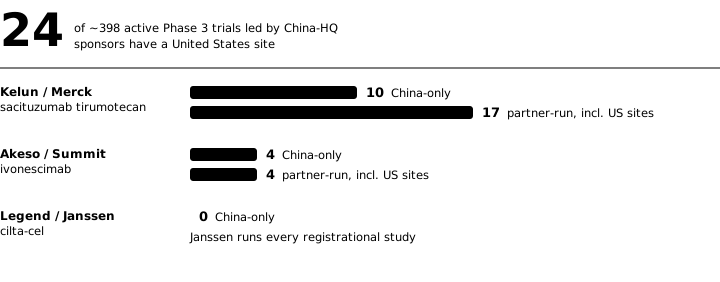
The pattern is the same in each case: the Chinese originator runs the China trials, and the Western partner runs the global ones. That is a trap, because it gets worse the longer you sit in it.
An unpartnered asset does not sit still while you look for a buyer. It accumulates exactly the kind of data that makes it harder to sell, because every quarter of China-only registrational work adds to what a buyer must spend on top of what you have already spent. A buyer is no longer being offered a licence. They are being offered a fresh global Phase 3, at their own cost, on an asset that has already consumed years of yours.
And the accumulation only runs one direction. You cannot un-run a trial, and the money is gone whether or not it bought you anything a partner wants.
That count comes from ClinicalTrials.gov, which is the honest limit of it. China-only registrations do not appear there, so the true number of Chinese Phase 3 trials is higher — but every one of those invisible trials is, by definition, China-only, which if anything sharpens the point rather than softening it. Elsewhere in this piece we have deliberately published very few per-target counts, because a differently-phrased query returns between 7% and 51% more records for the same target, so the counts are floors and are not comparable with each other. Anyone showing you a clean cross-target comparison of Chinese pipeline crowding has not tested that.
CARsgen's satri-cel is the world's first approved solid-tumour CAR-T. It has no ex-China partner, and its US trial has sat “active, not recruiting” since 2020. A buyer looking at that approval is looking at everything still left to do.
Where we might be wrong
The comparator argument is weaker than people claim. The usual version runs: Chinese trials fail in the West because they test against control arms the West has already moved past. There is something in it, but less than is assumed. ICH E10 explicitly preserves a superiority win over a weak comparator as valid evidence of efficacy. The EMA judges comparator adequacy as of the date a trial was designed, not the date it is reviewed — it said exactly that when it assessed Aplidin. And the FDA has no rule voiding a trial for a dated control arm.
“FDA rejects China-only data” is also too simple. Toripalimab was approved in October 2023 on a package the FDA's own notification calls “single region” — zero US sites. But that happened because applicability was never made an approvability issue for it; its complete response letter two years earlier was about virus testing on unprocessed bulks and a COVID-blocked site inspection. What the FDA rejects is China data alone. What it accepts, consistently, is China data as supportive alongside a multiregional trial — fruquintinib did it with FRESCO plus FRESCO-2, taletrectinib with TRUST-I plus TRUST-II.
So if the regulatory argument is contestable, why does any of this matter?
Because of something BeiGene's head of global R&D said in 2021, which is not contestable at all:
If you still use chemotherapy as the control arm, you very likely won't be able to enrol patients — because a patient who joins your trial faces a 50% chance of receiving pure chemotherapy, and they won't want to participate.
That is arithmetic about who walks into your clinic, and no regulator has to agree with it for it to bind you. Nor is the practice marginal. Of 453 randomised cancer-drug trials registered in China between 2016 and 2021, 60 — 13.2% — used a control arm that was not the guideline-recommended therapy, and in 58.3% of those the comparator was not recommended by any prior guideline for that indication at all. An estimated 18,610 patients were enrolled into them.
That is 13.2% of the trials but 15.1% of the patients — the trials with a non-standard control were the larger ones.
Where this leaves you
So stop asking how good your asset is. Ask how much time is left.
There is a pair of FDA decisions three months apart in which you can watch a window close in real time — same indication, same regulator, opposite answers. It is below, with the rest.
Three months
In October 2023, toripalimab was approved for nasopharyngeal carcinoma on a single-region Chinese package. The unmet need was real — nasopharyngeal carcinoma is concentrated in southern China and had no meaningful US alternative — and the FDA exercised the flexibility it reserves for exactly that situation.
Three months later, in January 2024, Akeso received a complete response letter for penpulimab. Same indication. The letter said its single-country study did “not provide a meaningful advantage over currently available therapy,” and instructed the company to run “a multiregional randomized clinical trial” enrolling “an adequate representation of U.S. patients.”
Akeso did it. AK105-304 ran fifty-six sites — thirty-seven in China, but also seven in Brazil, five in the United States, five in Australia, two in Canada. Approval came fifteen months after the refusal.
The unmet need that justified toripalimab's flexibility was consumed by toripalimab's own approval. Akeso's drug was not worse. It was three months late, into a window that had stood open for years and shut in a quarter.
Where each of twelve windows stands
We mapped twelve targets that Chinese biotechs are currently pitching. Three states.
The five targets where the evidence supports a window state. Seven others we studied are omitted: we could not establish their state without importing an assumption.

Open. PD-1/VEGF opened when HARMONi-A read out in 2024 and is still open. Five Chinese assets have reached Phase 3 or approval. Four of them are partnered, at $500 million to $1.25 billion upfront — including one that entered the target fifth. The fifth has no partner. Sinocelltech’s SCTB14 — identified in the company’s 22 May 2026 HKEX Application Proof as “a PD-1/VEGF bsAb candidate in Phase III clinical development” — is running a double-blind trial against pembrolizumab with no deal disclosed. The same filing says the company has “recently begun to establish our business development team” and frames out-licensing overseas rights as future income. DLL3 opened with tarlatamab's 2024 approval and produced three ex-China deals inside eighteen months, one of them signed days after first patient dosed.
Closed. On HER2 ADC the ex-China deals stop in 2023. Twelve Chinese programmes remain in Phase 3 behind that line, at least nine of them controlled against T-DM1. TROP2 closed as Trodelvy, Dato-DXd and sacituzumab tirumotecan locked the indication — four Chinese assets are in or past Phase 3 with no ex-China partner.
Never opened. EGFR/MET is the instructive case. Five Chinese bispecific ADCs, indistinguishable from each other on public data: all topoisomerase-I payloads, all drug-antibody ratio around four, all in advanced-solid-tumour dose escalation, all INDs cleared between 2024 and 2026. Zero ex-China deals. Amivantamab is approved, but it has not validated the target for ADCs — so there is no window to be early or late for. A crowded target with no open window is the worst position in this dataset, and five companies are in it simultaneously.
CLDN18.2 sits in a stranger place. Three Western buyers took a Chinese CLDN18.2 ADC and all three walked away — Merck returned SKB315, BMS returned LM-302, and Elevation discontinued EO-3021 citing a 22.2% response rate as “insufficient compared to other Claudin 18.2 ADCs.” So the assets did sell, three times, at real money — and all three came back. Whether that reflects the assets, the diligence that bought them, or a target that will not support this many entrants, the public record does not say.
What the CDE changed, and why nobody is watching
Most of the attention this year has gone to US policy — BIOSECURE, tariffs, the draft executive order that was never signed. None of those reach private in-licensing. Meanwhile China's own regulator has been steadily raising the cost of the fast-follower playbook, and almost nobody outside the regulatory function is tracking it.
2021. The comparator rule. Sponsors must provide “the best treatment widely applied in clinical practice,” and must not choose a therapy “already superseded by better drugs” in order to raise a trial's success rate. When a non-optimal control is used, CDE wrote, even a positive trial “cannot show the investigational drug meets patients' actual needs.”
March 2023. For tumours that already have a standard therapy, single-arm trials are generally not appropriate. Run a randomised controlled trial.
December 2025. Single-arm as a confirmatory study — the route from conditional to regular approval — is now explicitly a fallback for when an RCT cannot be conducted. “Not a routine option.”
March 2026, draft. The first explicit numerical test: later-line efficacy must be superior to, or comparable with, front-line standard of care before a sponsor may advance to the front line.
Read in sequence, these remove the strategy that produced most of the assets now sitting unpartnered. In a crowded target a standard therapy exists by definition — which forces the expensive path.
And then, in February 2026, CDE published something that reads almost as a recommendation. Its new guidance on benefit-risk assessment from multiregional trial data actively encourages global simultaneous development, states that ICH E17 “is currently the main basis on which Chinese review authorities evaluate MRCTs,” and tells sponsors to generate Chinese PK and safety data early — before joining the confirmatory multiregional trial.
That is your own regulator telling you to do what this article is telling you to do. It was published five months ago.
The four exits, and what the sellers kept
If the window is open and you are going to sell, the remaining question is what you sell it for. Four completed exits through NewCos — where a Chinese asset is licensed into a newly formed Western company built and funded to be acquired — now give us an answer, and it is not flattering.
In August 2023 Hengrui licensed an anti-TSLP antibody to a company that had not yet launched. Consideration: $21.5 million in cash, a $3.5 million near-term milestone, up to $1.025 billion in contingent milestones, a double-digit royalty. No equity.
Seventy-seven days after that licensee launched publicly as Aiolos Bio on a $245 million Series A, GSK agreed to acquire it for $1 billion upfront plus up to $400 million in milestones. Hengrui received no part of that consideration. GSK simply assumed the obligations Aiolos already owed Hengrui.
Three completed exits, on a shared scale. Upfronts are shown as points, not bars — at these ratios a shared bar scale is unreadable.
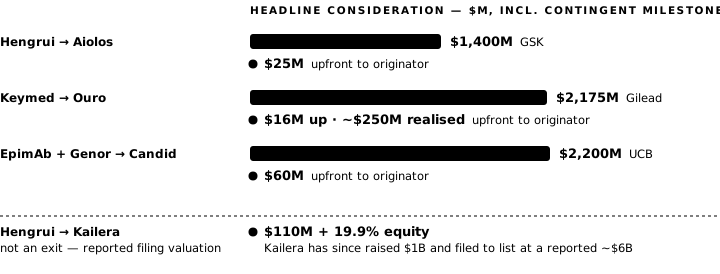
Be careful how you read that. Hengrui kept over a billion dollars of contingent milestones, a double-digit royalty, and all Greater China rights — and after the acquisition those obligations are owed by GSK rather than by a startup, which is materially better credit. What Hengrui gave away was the equity value created by repackaging, not the drug's economics — and the gap measures what Western packaging, syndication and $245 million of deployed capital are worth.
The same shape recurs. Keymed's equity in Ouro Medicines was extinguished at closing when Gilead paid $2.175 billion; Keymed received around $250 million plus up to $70 million. EpimAb's and Genor's stakes went into UCB's acquisition of Candid — $2.0 billion upfront plus up to $200 million in milestones.
Across every China-origin NewCo we verified, the originator gave up the entire world outside Greater China. Not one retained co-development, co-commercialisation, or a US opt-in.
The obvious conclusion is that Chinese originators are being systematically underpaid by these structures. Two things complicate that, and both matter.
The first is that the market repriced this inside a year. Nine months after Aiolos, Hengrui licensed its GLP-1 portfolio to the NewCo that became Kailera and took $110 million upfront plus 19.9% of the equity. Kailera has since raised $400 million, then $600 million, and filed for a Nasdaq IPO. Last July, Hengrui did a $500 million-upfront deal with GSK directly, with no NewCo in the middle. Aiolos was the last NewCo deal Hengrui signed without equity.
The second is that the discount reflects a capability gap rather than naivety. It is the same gap the trial counts describe: of roughly 400 active Phase 3 trials led by Chinese sponsors, twenty-four have a United States site. A buyer who must build the global development programme charges for building it.
There is one structure in the dataset that looks different. In Timberlyne Therapeutics, Keymed is the largest shareholder. That is the only arrangement we found that approaches genuine retained control, and it is worth studying before your next term sheet.
The test you can apply tomorrow
Two Hengrui assets, both described as retaining global rights.
SHR-A1904 runs a genuine multi-region Phase 1 — United States, Australia, South Korea, Moldova — funded by Hengrui.
SHR-A1811 has roughly ninety-nine trials, all in China, and unsold US, European and Japanese rights.
Only one of those is retaining global rights. The other is holding for a price that falls while it holds.
So: are you running trials the world will accept, or are you running Chinese trials and calling the rights an asset? Look at your own registrations and answer honestly. Everything else in this article is downstream of that answer.
Four things to negotiate differently
Do not sell ex-China as a single block. Every NewCo deal we verified did exactly that. Split United States, Europe, Japan and emerging markets. They have different buyers, different timing and different competitive dynamics, and bundling them is the seller's single largest unforced concession.
Take equity, and structure it to survive a change of control. Keymed's Ouro stake was extinguished at closing. The originators behind Windward — Harbour BioMed and Kelun-Biotech, whose anti-TSLP antibody it holds — priced in being flipped, with explicit change-of-control triggers. If your counterparty is a NewCo, its exit is the most likely outcome — negotiate for that outcome, not against it.
Enter the global trial early. The additive pattern is what FDA accepts: keep the China trial as supportive and add a multiregional trial. Fruquintinib did it with FRESCO plus FRESCO-2. Taletrectinib did it with TRUST-I plus TRUST-II. Both are approved in the United States. And in the Tevimbra file there is a sponsor who saw this coming mid-trial and increased its sample size specifically to enrol a hundred patients outside Asia, “due to concerns that the lack of geographically diverse population would likely not be acceptable for global registrational purposes.”
Watch the clock. Crowding tells you very little. What matters is whether the first Western approval in your indication has landed, because that is when the flexibility you are relying on gets consumed. On the one pair we can trace in detail it did not come back; whether that holds generally, nobody has enough cases to say.
What it costs to do it yourself
So why not run the global programme yourselves and keep everything?
One company did. BeOne built an in-house clinical organisation of roughly 3,800 people across six continents, explicitly to run trials without CROs — its own filings note that clinical trials are more than 75% of the cost of bringing an oncology medicine to patients, and that the industry keeps outsourcing that function. It then inverted its revenue mix to US-majority and moved its legal domicile from the Cayman Islands to Switzerland.
Roughly 3,800 clinical staff and a change of domicile. That is the price, and BeOne is the only company that has paid it.
Akeso is attempting a narrower version: AK104-311, a 900-patient Phase 3 of cadonilimab plus chemotherapy against chemotherapy with or without nivolumab, with sites in China, Germany, Poland and the United States, and no partner. Whether a company that size can carry a Western registrational trial alone is not yet answerable, and will not be for some years.
For everyone else, partnering is the only available route to a global registrational programme — which puts the timing of it among the more consequential calls your board will make, and on current evidence it is being made late more often than early.
Get the underlying dataset
218 Chinese oncology programs across the twelve targets in this piece — company, asset, modality, stage, indication, ex-China licensing status, a source link and a confidence grade on every row. XLSX and CSV.
BioRich International advises Chinese biotechs on out-licensing to Western partners. If you want a read on where your asset sits in this picture, get in touch.
lisa.fan@biorichinc.com